How Automotive Plastic Panels Are Manufactured: From Sheet to Finished Part
- Share
- From
- www.polyreflex.com
- publisher
- Polyreflex
- Issue Time
- May 28,2026
Summary
Learn how automotive plastic panels are manufactured from thermoplastic sheets to finished components. Explore materials, CNC machining, vacuum forming, and custom automotive solutions by Polyreflex.
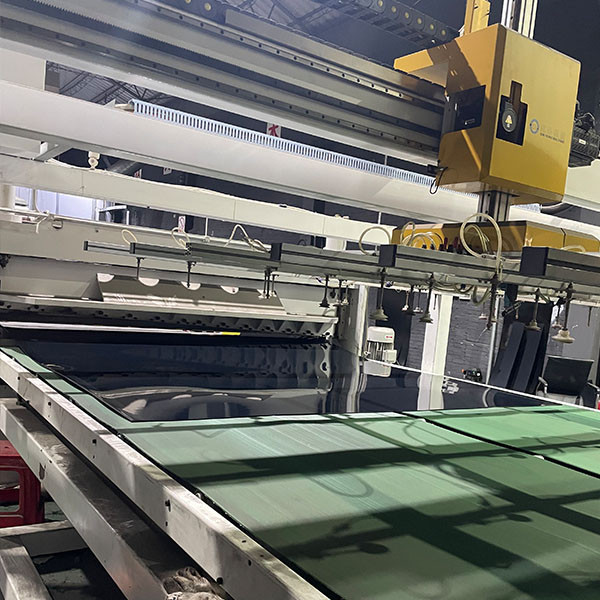
Modern vehicles rely heavily on lightweight thermoplastic materials to improve fuel efficiency, reduce emissions, and support advanced vehicle designs. From passenger cars and commercial vehicles to electric vehicles and specialty transportation equipment, automotive plastic panels are now widely used in both interior and exterior applications.
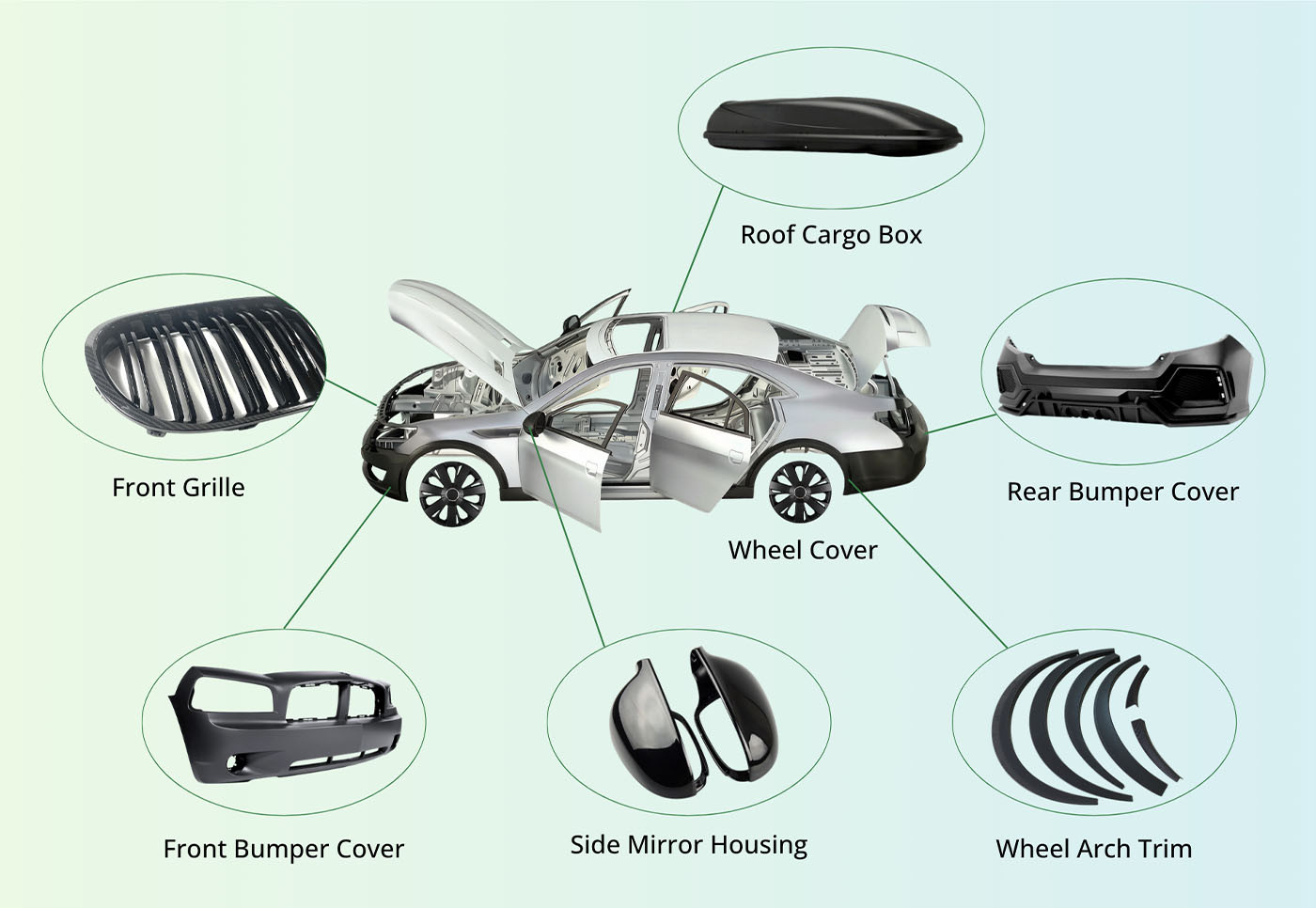
Today, automotive manufacturers use plastic panels for a wide range of components, including trunk floor boards, seat back panels, door panels, interior wall panels, roof headliners, floor systems, underbody shields, wheel arch liners, and protective covers. Compared with traditional metal or wood-based structures, thermoplastic panels offer major advantages in lightweight performance, durability, moisture resistance, and manufacturing flexibility.
Several materials are commonly used in automotive panel manufacturing, including PP Honeycomb Panels, PP Bubble Boards, ABS Sheets, and TPO Sheets. These materials can be further processed through CNC machining, vacuum forming, thermoforming, drilling, cutting, and assembly to create finished automotive components.
In this article, we will explore how automotive plastic panels are manufactured — from raw plastic sheets to finished automotive parts — and how Polyreflex provides customized material and fabrication solutions for automotive customers worldwide.
Why Automotive Manufacturers Use Thermoplastic Panels
The Demand for Lightweight Vehicles
Lightweight design has become one of the most important trends in the global automotive industry. Vehicle manufacturers are constantly searching for ways to reduce overall vehicle weight without sacrificing strength, durability, or safety.
For electric vehicles, lightweight materials are even more critical. Reducing vehicle weight helps improve battery efficiency and driving range. For traditional fuel vehicles, lightweight structures contribute to better fuel economy and lower carbon emissions.
Automotive plastic panels play an important role in this trend because thermoplastic materials can replace heavier metal, plywood, or solid structures in many non-structural and semi-structural applications.
In addition to weight reduction, thermoplastic panels also simplify manufacturing and assembly processes. Their flexibility allows designers to create more complex shapes while reducing the number of components required in a vehicle system.
Advantages of Thermoplastic Materials
Thermoplastic materials offer several important advantages for automotive applications:
Lightweight Performance
Plastic honeycomb and bubble structures provide excellent stiffness while maintaining very low weight. This makes them ideal for interior panels, cargo systems, and protective components.
Impact Resistance
Automotive components are exposed to vibration, impacts, and continuous mechanical stress. Materials such as PP, ABS, and TPO provide strong impact resistance and durability.
Moisture Resistance
Unlike wood-based materials, thermoplastic panels do not absorb water or swell under humid conditions. This is especially important for vehicle floor systems and exterior protection parts.
Recyclability
Many thermoplastic materials are recyclable, supporting sustainable automotive manufacturing and environmental goals.
Design Flexibility
Thermoplastics can be easily cut, thermoformed, vacuum formed, laminated, and assembled into customized automotive parts.
Cost Efficiency
Thermoplastic sheet production and processing can reduce overall manufacturing costs while improving production efficiency.
PP Bubble Board
ABS Sheet
Common Plastic Materials Used in Automotive Panels
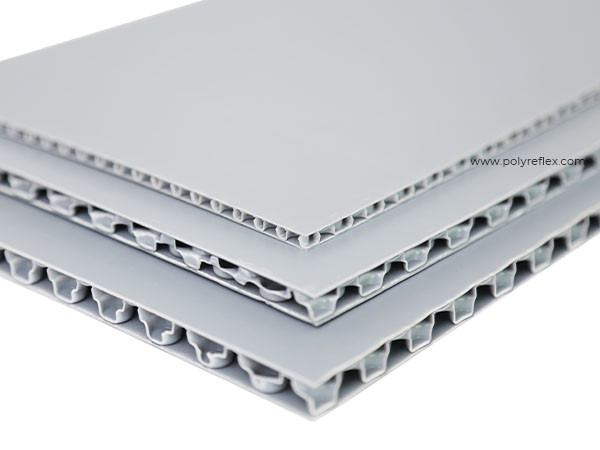
PP Honeycomb Panels
PP Honeycomb Panels consist of a lightweight polypropylene honeycomb core laminated with flat thermoplastic skins. The honeycomb structure provides an excellent stiffness-to-weight ratio.
Common Automotive Applications
Advantages
PP Honeycomb Panels are especially suitable for applications requiring both lightweight performance and structural support.
PP Bubble Board
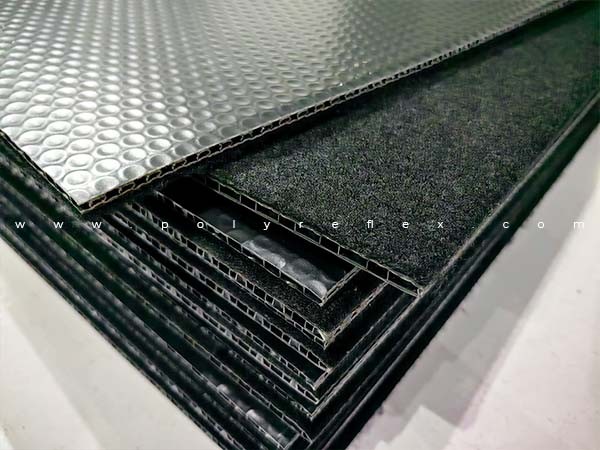
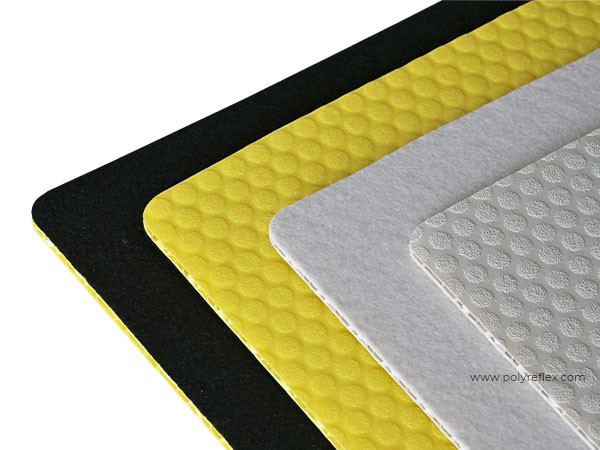
PP Bubble Board features a circular bubble-structured core that combines lightweight performance with durability and cost efficiency.
Common Applications
Advantages
Because of its lower material cost and versatile performance, PP Bubble Board is widely used in mass-production automotive interior applications.
ABS Sheets
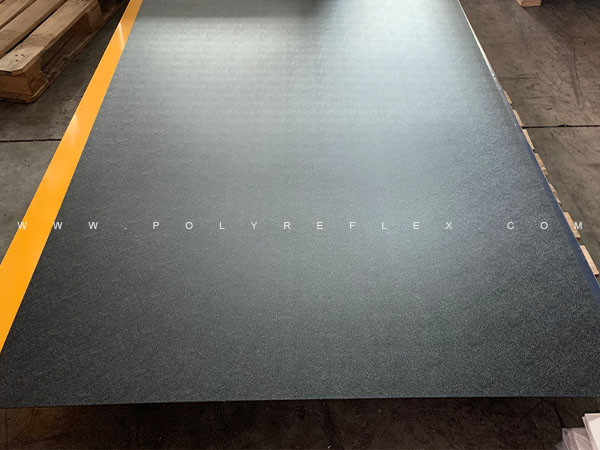
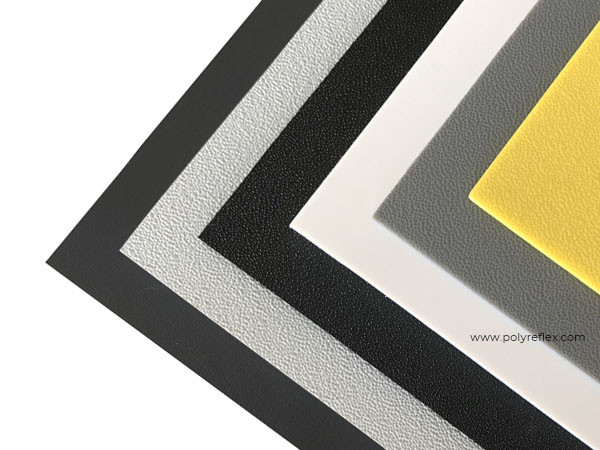
ABS Sheets are widely used in automotive interior manufacturing due to their excellent thermoforming capability and surface appearance.
Common Applications
Advantages
ABS Sheets can also be laminated with fabric, leather, or decorative films to improve aesthetics.
TPO Sheets
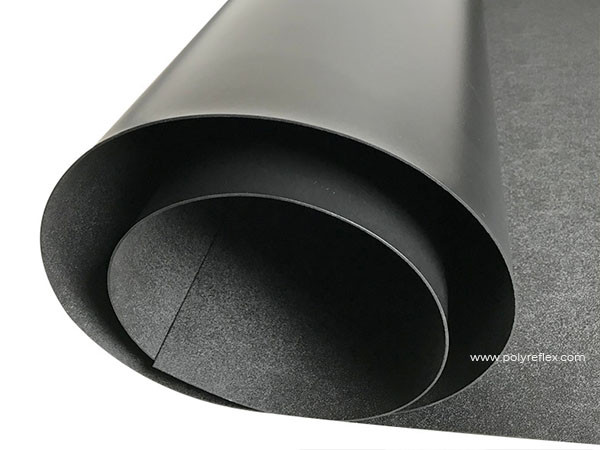
TPO (Thermoplastic Olefin) Sheets are commonly used in automotive exterior applications because of their weather resistance and flexibility.
Common Applications
Advantages
TPO materials are especially suitable for harsh outdoor automotive environments.
Step 1 – Plastic Sheet Extrusion and Material Preparation
The manufacturing process begins with raw material preparation and sheet extrusion.
Plastic resins such as polypropylene, ABS, or TPO are first mixed with additives, fillers, stabilizers, or color masterbatches depending on the application requirements. These raw materials are then melted and processed through extrusion equipment to produce continuous thermoplastic sheets.
During the extrusion process, manufacturers carefully control:
For automotive applications, consistency is extremely important because panels must meet strict dimensional and performance standards.
Different surface textures can also be produced during extrusion, including:
If printing or lamination is required, corona treatment may be applied to improve surface adhesion.
Polyreflex provides customized sheet specifications based on customer requirements, including thickness, weight, color, surface texture, and mechanical performance.
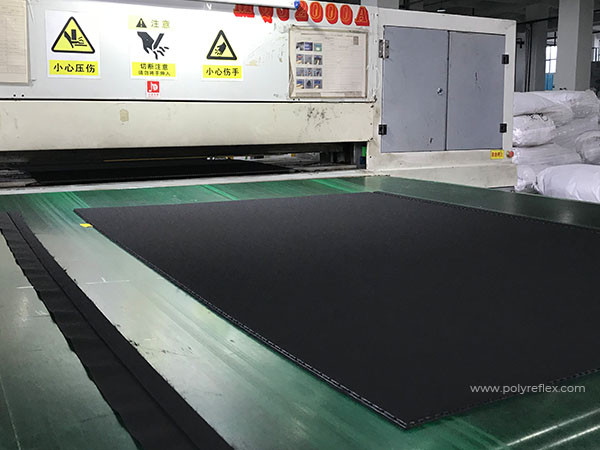
PP Bubble Board Production
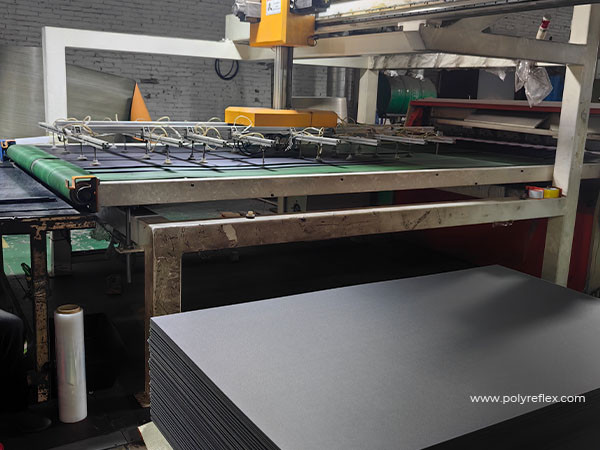
ABS Sheet Production
Step 2 – CNC Cutting and Precision Machining
After sheet production, the next step is precision fabrication.
Why CNC Machining Is Important
Automotive panels often contain complex shapes, mounting holes, clips, slots, and curved edges. Manual cutting cannot achieve the consistency required for automotive production.
CNC machining ensures:
Precision processing is especially important for OEM and Tier-1 automotive suppliers.
Common CNC Processes
Automotive plastic panels are commonly processed using:
Contour Cutting
Cutting the outer shape of the panel according to CAD drawings.
Drilling
Creating mounting holes and assembly positions.
Slotting
Producing grooves or slots for clips and fasteners.
Edge Trimming
Removing excess material after thermoforming.
Engraving or Marking
Adding identification marks or assembly references.
Custom Fabrication Capabilities
Modern automotive manufacturing requires flexible customization capabilities.
Polyreflex supports:
This allows customers to move efficiently from concept design to finished automotive components.
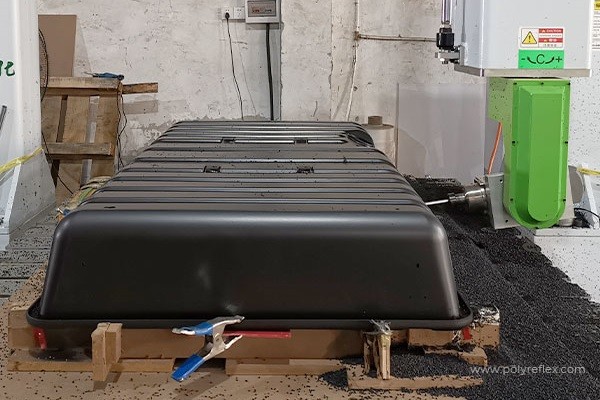
CNC Machining
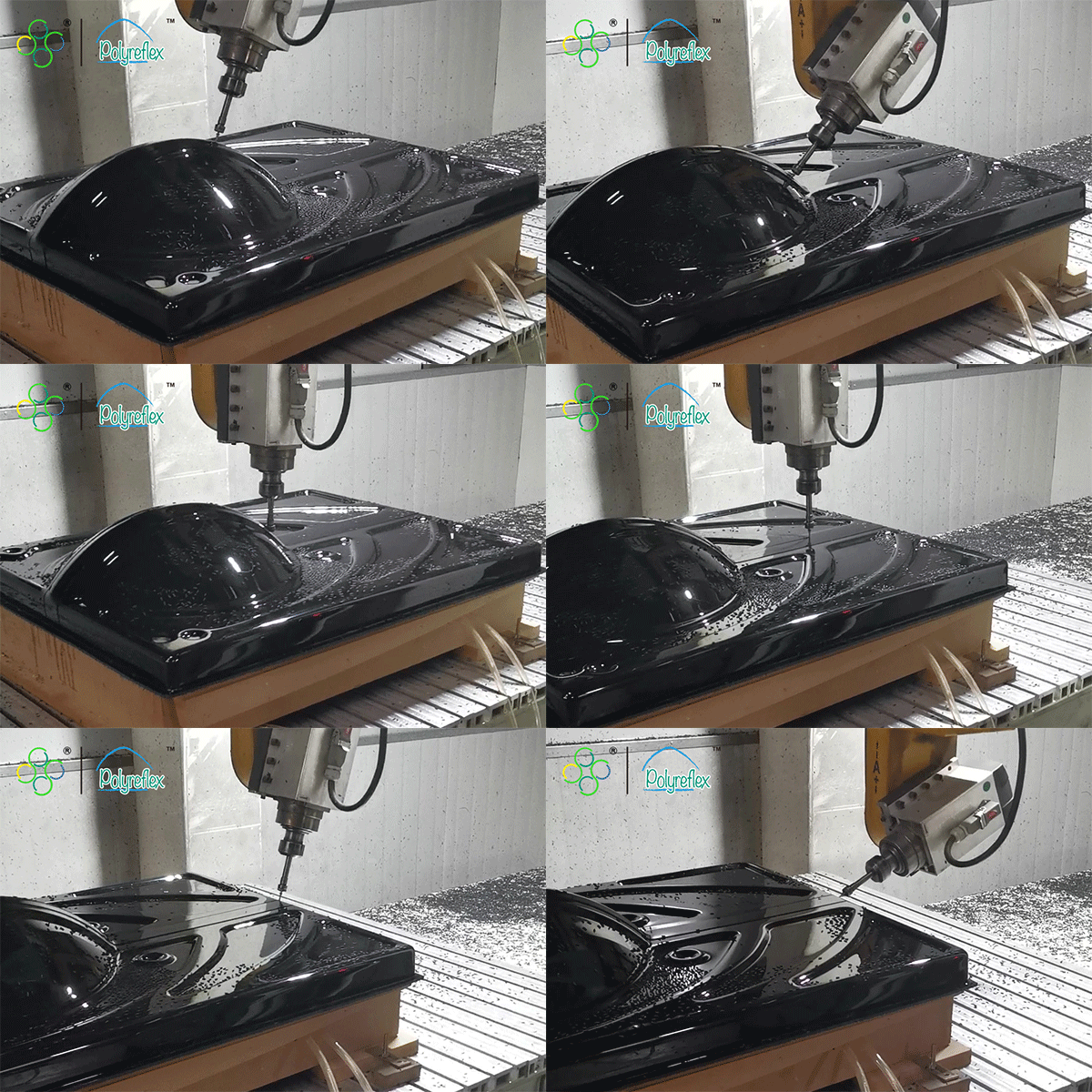
ABS Part CNC Machining
Step 3 – Thermoforming and Vacuum Forming
Many automotive panels require three-dimensional shapes rather than flat sheets. This is where thermoforming and vacuum forming become essential.
How Vacuum Forming Works
Vacuum forming is a process where a thermoplastic sheet is heated until soft and then formed over a mold using vacuum pressure.
The process typically includes:
1. Heating the plastic sheet
2. Positioning the sheet over the mold
3. Applying vacuum pressure
4. Cooling and shaping
5. Trimming excess material
This process allows manufacturers to create lightweight automotive components with complex geometries.
Applications in the Automotive Industry
Vacuum forming is commonly used for:
Materials such as ABS and TPO are especially suitable for thermoforming applications.
Benefits of Thermoforming
Compared with injection molding, thermoforming offers several advantages for automotive panel production:
Lower Tooling Costs
Tooling investment is lower, making it suitable for medium-volume production.
Faster Development Cycles
Prototype development and product modification can be completed more quickly.
Lightweight Structures
Thermoformed parts maintain low overall weight.
Large Part Capability
Large automotive panels can be produced efficiently.
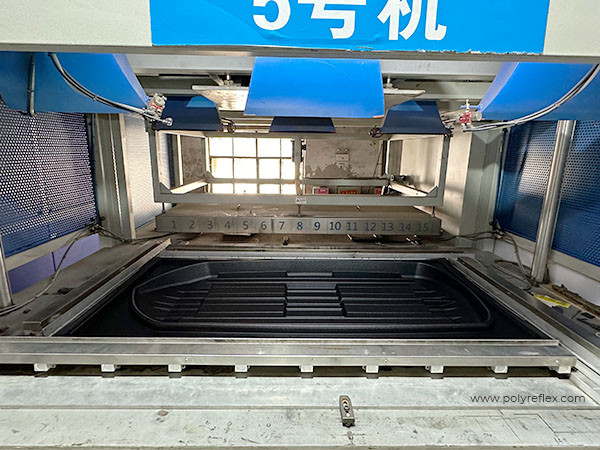
Roof Cargo Boxes Vacuum Forming
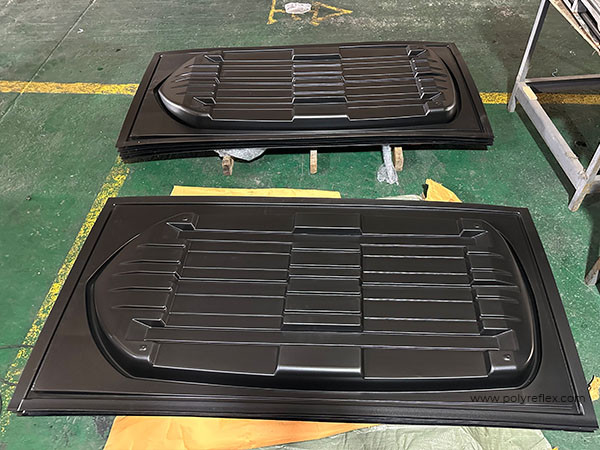
Roof Cargo Boxes after Vacuum Forming
Step 4 – Assembly and Surface Finishing
After fabrication and forming, automotive panels move into finishing and assembly stages.
Surface Lamination and Decoration
Many automotive interior panels require decorative or functional surface layers.
Common finishing methods include:
These finishing processes improve both aesthetics and durability.
Joining and Reinforcement Methods
Automotive plastic panels are often combined with other materials or structural systems.
Common assembly methods include:
Depending on the application, additional foam, insulation, or reinforcement materials may also be integrated into the panel system.
Quality Control in Automotive Plastic Panel Manufacturing
Automotive manufacturing requires strict quality control throughout the production process.
Dimensional Accuracy
All panels must meet precise dimensional tolerances to ensure proper assembly.
Impact Resistance Testing
Panels must withstand vibration, impact, and repeated use during vehicle operation.
Heat and Weather Resistance
Exterior automotive components must resist:
Consistency in Mass Production
For OEM and Tier suppliers, production consistency is critical. Every panel must maintain stable quality across large production volumes.
Polyreflex maintains strict quality standards to ensure reliable automotive material performance.
Custom Automotive Plastic Solutions by Polyreflex
Polyreflex is a professional manufacturer of thermoplastic sheets and automotive panel solutions for global automotive customers.
Our automotive material portfolio includes:
In addition to material supply, Polyreflex also provides comprehensive processing services, including:
We support OEM customization with:
Our materials and fabricated components are widely used in:
By combining material manufacturing with fabrication capabilities, Polyreflex helps customers simplify their supply chain and improve manufacturing efficiency.
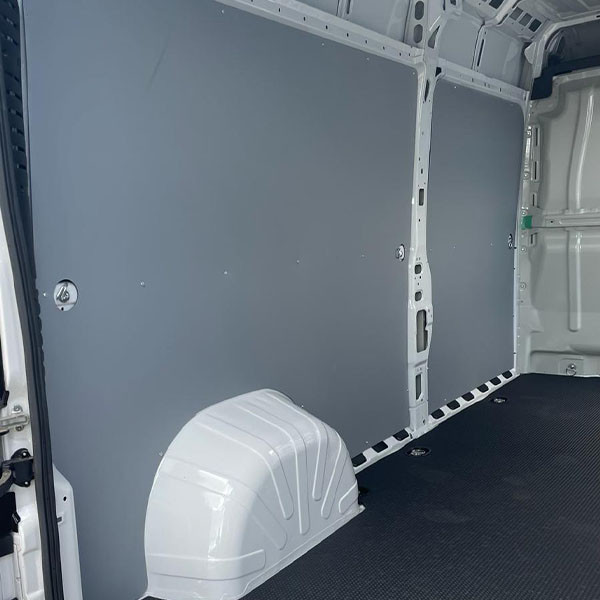
Lightweight PP bubble board and honeycomb panels for automotive interior wall, ceiling, and floor applications. Durable, moisture-resistant, and customizable.
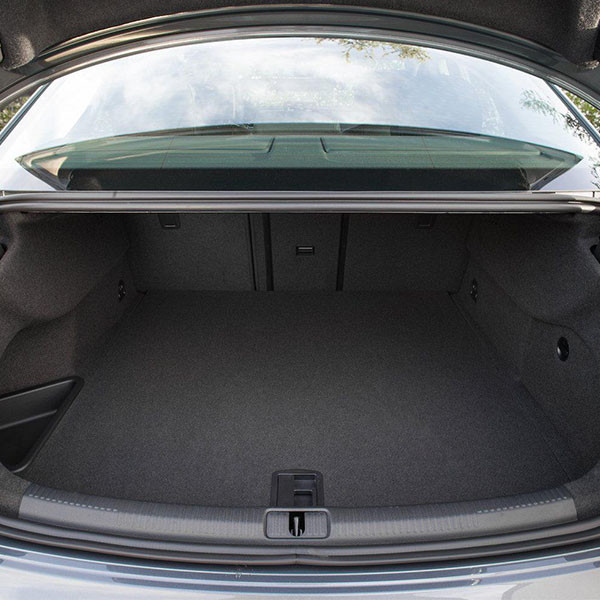
Lightweight and durable automotive trunk floor panel solutions using PP bubble board and honeycomb materials. Designed for high load capacity, moisture resistance, and OEM customization across modern vehicle cargo systems.
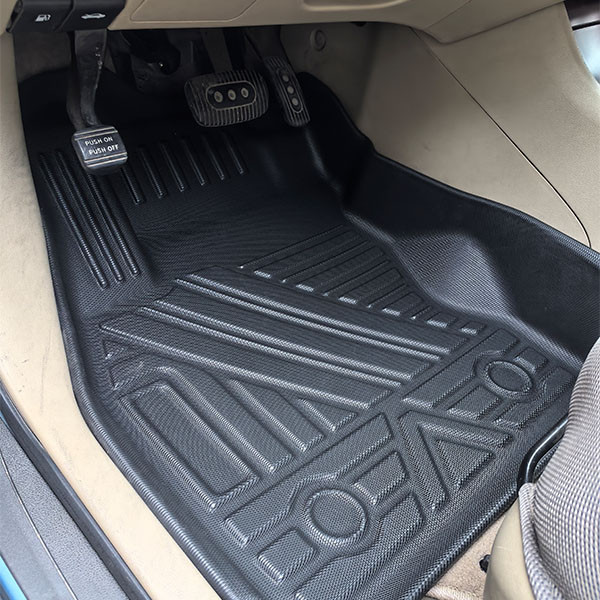
Polyreflex provides high-performance TPO/TPE thermoplastic sheets for automotive floor mats, trunk liners, and cargo protection systems, offering excellent durability, waterproof performance, and thermoforming compatibility for OEM applications.
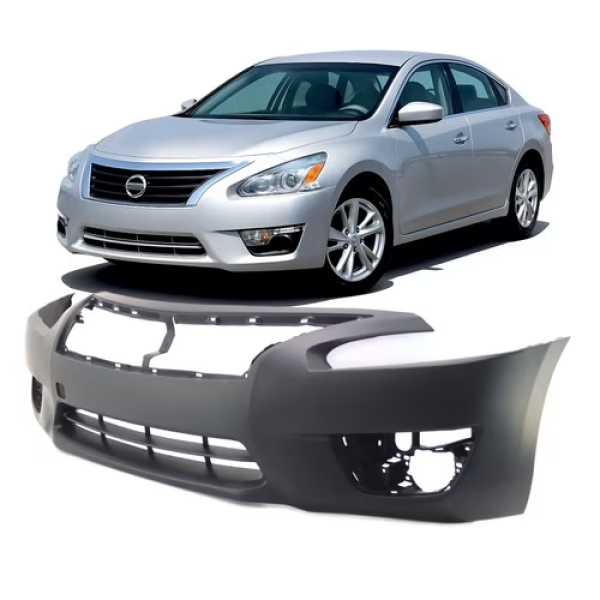
High-performance automotive exterior body panels made from ABS and TPO materials. Polyreflex offers durable, lightweight, and customizable thermoformed solutions with excellent surface finish and weather resistance.
Future Trends in Automotive Plastic Panel Manufacturing
As the automotive industry continues evolving, thermoplastic panel manufacturing will become even more important.
Several major trends are shaping the future:
EV Lightweighting
Electric vehicles require lighter materials to maximize battery efficiency and driving range.
Sustainable Materials
Recyclable thermoplastics are becoming increasingly important in environmentally responsible vehicle production.
Integrated Functional Panels
Future automotive panels may integrate multiple functions, including insulation, protection, and decorative performance.
Advanced Surface Technologies
New surface treatments and laminations will improve durability and aesthetics.
Modular Manufacturing
Automotive manufacturers are increasingly adopting modular panel systems for faster assembly and reduced production costs.
Conclusion
Automotive plastic panels have become essential components in modern vehicle manufacturing. From lightweight interior systems to durable exterior protection parts, thermoplastic materials provide significant advantages in weight reduction, durability, flexibility, and manufacturing efficiency.
The manufacturing process — from sheet extrusion and material preparation to CNC machining, thermoforming, assembly, and quality control — requires both advanced materials and professional fabrication expertise.
With extensive experience in thermoplastic sheet manufacturing and automotive processing solutions, Polyreflex provides customized automotive plastic panel materials and fabrication services for OEMs, Tier suppliers, and industrial customers worldwide.
Whether you require lightweight PP Honeycomb Panels, thermoformable ABS Sheets, durable TPO exterior materials, or custom automotive panel fabrication, Polyreflex can support your project from material supply to finished component production.
FAQ
What materials are commonly used for automotive plastic panels?
Common materials used for automotive plastic panels include PP Honeycomb Panels, PP Bubble Boards, ABS Sheets, and TPO Sheets. Each material offers different advantages depending on the application, such as lightweight performance, impact resistance, thermoformability, or weather resistance.
What automotive parts can be made from plastic panels?
Automotive plastic panels are commonly used for:
Trunk floor boards
Seat back panels
Door panels
Interior wall panels
Roof headliners
Floor panels
Underbody shields
Wheel arch liners
Mud guards
Cargo systems
What is the advantage of PP Honeycomb Panels in automotive applications?
PP Honeycomb Panels provide an excellent stiffness-to-weight ratio. Their lightweight honeycomb core structure offers high rigidity while reducing overall vehicle weight, making them ideal for trunk boards, seat back panels, and lightweight structural components.
Why are ABS Sheets widely used for automotive interior parts?
ABS Sheets offer excellent thermoforming capability, impact resistance, and surface appearance. They are commonly used for door panels, interior trim parts, and decorative automotive components that require complex shapes and high-quality finishes.
What manufacturing processes are used for automotive plastic panels?
Common manufacturing processes include:
Sheet extrusion
CNC cutting
Drilling
Thermoforming
Vacuum forming
Edge trimming
Surface lamination
Assembly
These processes help transform flat thermoplastic sheets into finished automotive components.
How does Polyreflex support automotive customers?
Polyreflex provides both thermoplastic sheet materials and fabrication services for automotive applications. The company offers PP Honeycomb Panels, PP Bubble Boards, ABS Sheets, and TPO Sheets, along with CNC machining, vacuum forming, custom cutting, and OEM manufacturing support.